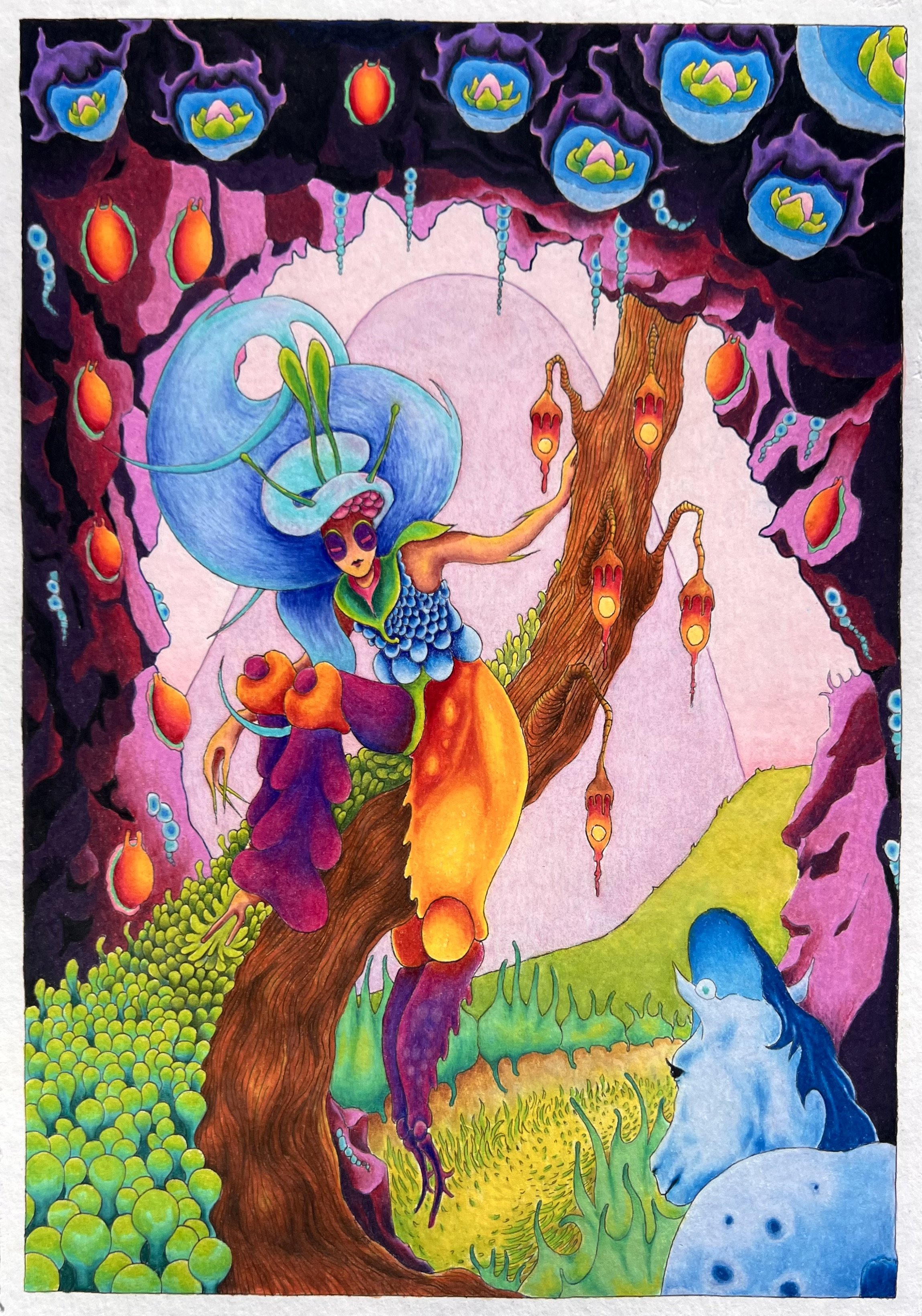
Driftera’s biome consists of vibrant green meadows with ginormous rock boulders and tree arches, creating a perfect amphitheater for light and sound. There exists a perpetual music that interacts with the gravity in this land, and sunlight filters through the outer biome to warm up the surface during the day.
It’s inhabitants, Driftlings, have inhabited Driftera since its formation, thousands of years ago. One quiet morning, a collection of boulders found themselves in a unique pattern deep beneath the ancient waters of the Arbane sea. Within all rocks there exists a potential energy, but unless they are found to be perfectly distanced from each other, they remain rocks.
A tiny shrimp was flung against one of the boulders by a mischievous octopus, resulting in the shrimp’s immediate death. This impact nudged the boulder a milimeter, initiating a monumental change in gravity.
As a result, the perfect collection of boulders lifted from the sea floor, along with all the creatures inhabiting the space (they didn’t really have a choice). The organisms underwent change, morphing into driftlings: an unusual combination of the life existing in that very moment, across the affected surface area. The driftlings are in a perpetual state of nascent nature; they are able to experience conjugal and paternal/maternal love, but are not subject to vanity or contempt, shame or envy.
Because they have never known inequality or strife, the protector sits at the entrance to Driftera, and decides whether or not an individual seeking entrance would infect the Driftlings with the dregs of modern society. As they have had everything available to them from the very beginning of their existence, the Driftlings do not need to evolve. They exist in their environment perfectly.
The magnetic pull of Driftera enables the mass to travel expansive distances in search of a safe, warm area. For the last 50 years, this has been far off the coast of Wefala. The Driftlings understand that Wefala has been corrupted by the Arch-Wef, and have chosen to remain at distance where they are undetectable but can also observe it. They are also aware of Fapi, and are expecting her arrival.
Flora
Malachite moss grows on the parts of rock that are exposed to the sun during the day. Particles of dusk act as a catalyst for the head-like domes of Malachite Moss to release a brilliant life-light. The malachite fields resemble a drifting starfield at night. Translucent curlicue roots hang from tree arches like curtains, absorbing moisture from the creek mist, and twinkling as wind passes through them. Fueled by the resonance of the energy within the rocks. Cuepula flourishes in the cracks of stone, collecting sunlight during the day like how a bucket collects rain water. As the sun filters through the Cuepula, it is converted into sungoo, a substance that can be used at night time to illuminate dark places. It is also a substance used by the inhabitants of Driftera to decorate themselves. Noletta reeds grow close to water, and use their little feet to grip onto Curlicue Roots and Malachite Moss. High levels of humidity enable the Nolleta to uncoil and sway in time to the twinkling sounds of the dangling Curlicue. Sorsea petals obtain nutrients from sound. They enjoy the echo of water dripping on stone, and tend to populate areas where these noises can be heard. When they grow inside damp caves, their petals create large dry pockets where the inhabitants of Driftera can live. Glasser fruit is the primary source of food for driflings. They bud from curlicue roots, growing into coconut sized orbs that fill with cool mineral water. When moonlight hits a ripe glasser fruit, it will crack open, allowing for driflings to feast on its rich liquid. Once it’s been ingested, the casing can be ground down into a fine powder used for baking treats like pompelmur and pindamoes.