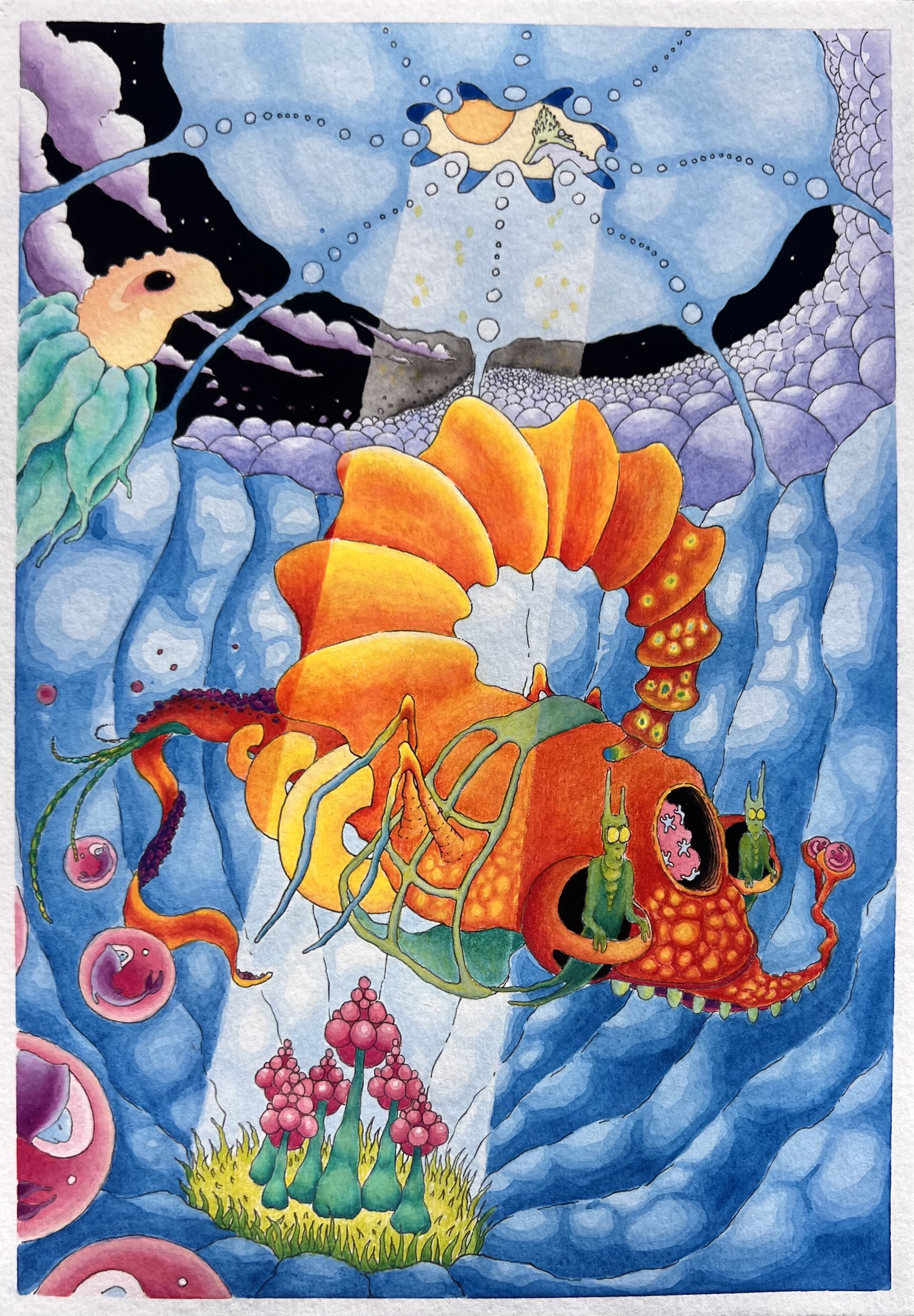
In the depths of the Great Sunlands there exists a pool of similar shape and size to the watering holes of Wefala.
Little Gip possesses marvelous inventing skills, and fashioned a Kapix mask for Fapi so that she could brave the colorless plains of the Great Sunlands. Fapi was in search of a secluded and desolate place to roam, away from the eyes of her three headed foes.
[Kapix tree: from a time when the Great Sunlands bore life, one of the only truly blind plants to exist. It evolved to reflect the colorlessness of the planes, and its leaves will protect Fapi from the dangers of not consuming enough color. For those of her kind, color is as oxygen is to humans.]
[Kapix mask: carries the foliage of the Kapix tree, native to the Riasphere. Not only did Gip think to create openings for Fapi’s mane, but also a small bubble on the ear shield for him to reside.]
Fapi arrived at a small body of water (or water-like substance) that closely resembled the watering holes back home in Wefala. To her surprise, this one wasn't firmly stuck on a rock, but skittered across the planes on its purple tentacle-like legs. It looked more like a creature than a watering hole, with a very flat and reflective back. As Fapi approached the anomaly, it became aware of her colorful presence but did not move.
Unknown to Fapi, this creature was not a creature, but a sentient portal leading to the undiscovered Oasis of Ish.
Oasis of Ish
The substance of the oasis is of much greater density than water. As a result, its organisms contain massive amounts of power. If you were to catch, say, an Orcal in its Plish pod, and set it free in Wefala, it would zoom through the sky quicker than the Golden Snitch. This also means that if Fapi were to jump into the portal, she would find herself quite immobile.
The hole created by the portal is the primary source of light for the oasis. When the sun is at its peak, a powerful spotlight shines into the depths of the oasis, creating the means necessary for Plish to flourish. If not more important for the Plish is the indirect sunlight emitted from the full moon each month. Due to a lesser occurrence and heightened importance, the inhabitants of Ish conduct a monthly ritual in celebration of the moon to display their gratitude for providing them with food.
[Plish: a raspberry-like tree with multiple individual Plish pods, each containing a singular fractal, or plankton. Also the delicious source of sustenance for the Orcal.]
[Orcal: a permanently curved fish native to Ish, purple in color. The Orcal eats by merging into a fresh Plish pod every month, similarly to how cells join together. Not only does the pod provide an environment in which the Orcal can breathe and absorb nutrients, but it is also the primary source of motion, propelling the Orcal across the vast oasis. As mentioned earlier, each pod contains one fractal, which serves to keep the Orcal company within its pod. Regarding size, the Orcal is of similar size to Fapi. On the rare chance that an Orcal is unable to make the transition into a fresh pod, the stale environment of the old pod will suffocate the Orcal, and it will pop. This occurs if the Orcal cannot locate a fresh pod, or if there are no fresh pods as a result of a lack of sun/moonlight. This is detrimental because the Orcal is the primary source of food for the Crinn.]
The oasis has a unique layout: every dome besides that which enjoys the light from the portal remains in a darkness so void that the eye must shut itself. However, it is not void of color, as its inhabitants have evolved to emit a life-light spanning every color. The domes span to infinity, and organisms across this expanse find ways to congregate together through their life-light, as well as vibrations in the substance.
[Crinn: to survive, the Crinn must create and maintain symbiotic relationships with smaller organisms that attach to it. The delicacy of the food chain in the oasis emphasizes the miracle by which a creature like this exists, as the removal of even a single participant causes its entire system to collapse. In regards to ferocity and terror, the Crinn acts like a whale, eating only organisms low on the food chain, like the Orcal. It uses tongs (a trunk-like limb) to pluck its food from the substance, maneuvering it slowly into its mouth. The only sound the Crinn emits is the chattering of its rounded teeth, and it does this when stressed or overwhelmed. The purpose of the Crinn is to act like a vessel for which others can inhabit. For example, the brain of the Crinn is overpopulated with giggles, little guys that squeeze the brain to keep it functioning. ]
[Shrinkish: reside in the ‘spectacles’ of the Crinn, advising it in matters of direction and location of sustenance.]
[Nana-Wiff: survives on oasis fractals, the ‘plankton’ of Ish. It likes to bask in the body net of the Crinn and absorb the life-light coming from the three lower rings.]
[Wob: If, for whatever reason, the Wob releases its mouth pebble and the air inside is released, the pressure of the oasis suffocates the stomach gremlins who live an exceptionally lavish lifestyle inside the safety of the Wob.]
[Pleb: it is what it is, a slave. It is a slave to the fractals, as it houses their congregations. Evolution keeps this in flux, as overtime, the Pleb will break free from its confines, and those who live lavish lifestyles will take its place through reincarnation.]
It’s ironic, because in order for the Great Sunlands to thrive as it used to, it would greatly benefit from having something like the Oasis of Ish lie below. Not only would the substance nourish the depleted and dry planes, but the self emitting life-light of its organisms would bring a massive return of color.